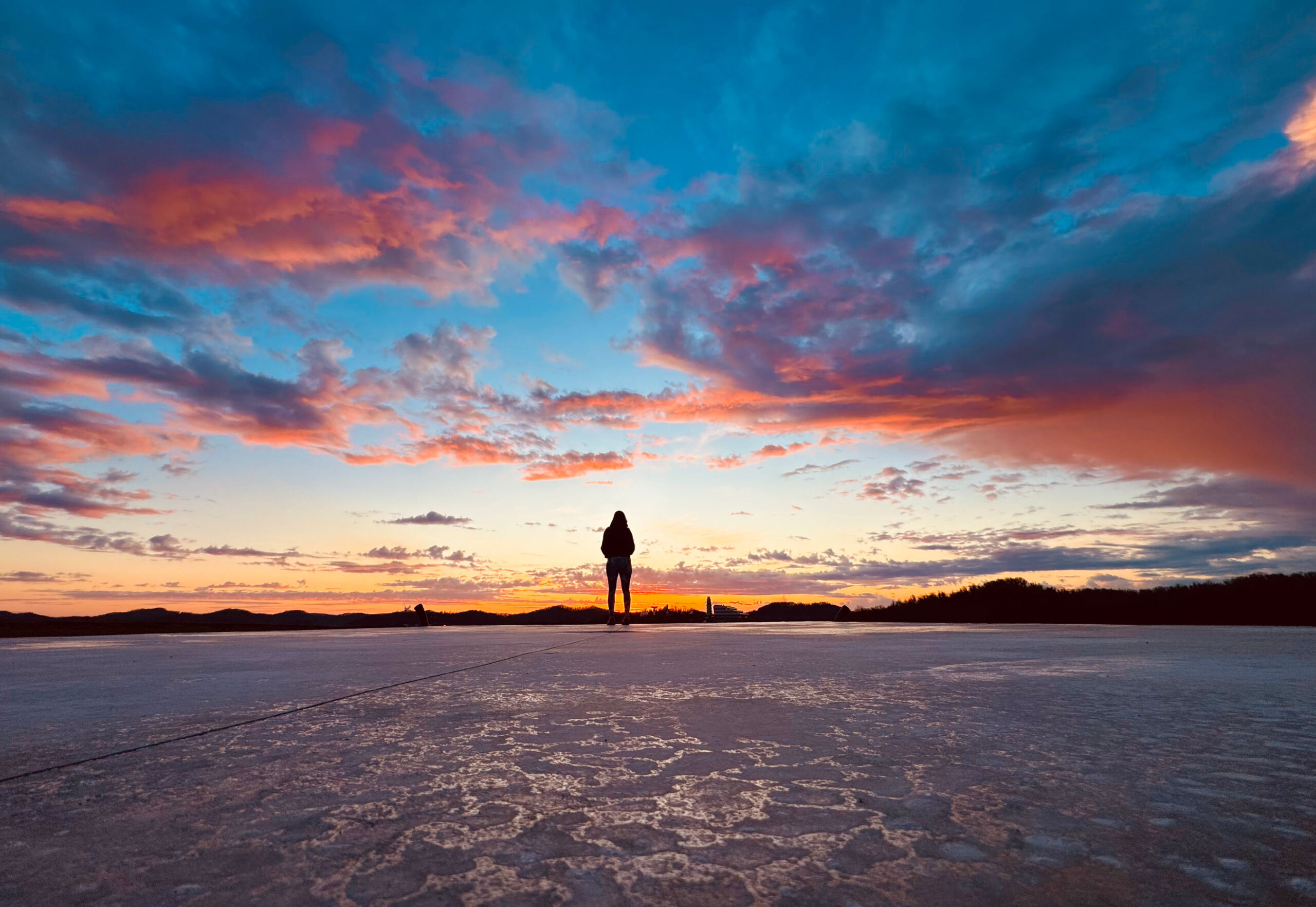
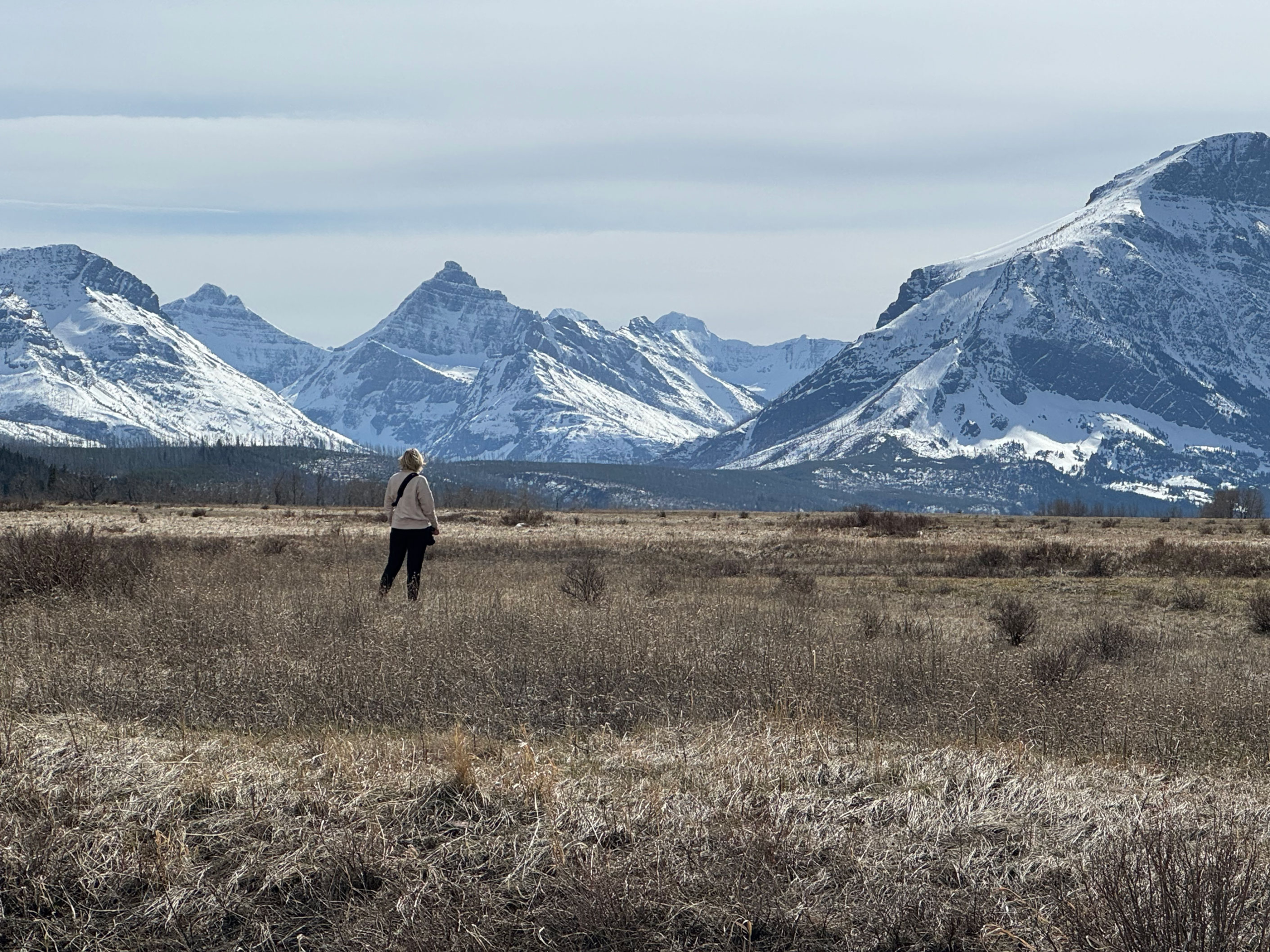
One of the things taught in a wilderness survival course is that, if you find yourself lost, without a map, a compass, or other navigational device, the best thing you can do is pick an immovable object on the distant horizon, and keep that object always in view as you walk toward it. A single degree off in either direction could, over the course of many miles, completely alter your destination.
The terrain in the wilderness often causes you to pull your eyes from the horizon to address more immediate obstacles, like crossing a river, loose rocks shifting underfoot, roots entangling your feet, or thick brush that obscures your view or forces you around it. Sometimes you must look down just to keep from stumbling, but each time the ground releases your attention, you lift your gaze again to the immovable object on the horizon, because it is the only way to be certain that no obstacle has quietly pushed you to the right or to the left of your path.
We receive this admonition in Hebrews 12:2, “And let us run with perseverance the race marked out for us, fixing our eyes on Jesus, the author and perfector of our faith,” or more pointedly in the Amplified Version: “[looking away from all that will distract us and] focusing our eyes on Jesus, who is the Author and Perfecter of faith…”
The phrase translated “fix your eyes” in the text comes from the Greek term aphoraō, meaning “to turn the eyes away from other things and fix them on something.” And that word comes from two root words, horaō – “to look in order to perceive, to become acquainted with by observation”, and apo – “separation”. So, when we are told to “fix our eyes on Jesus”, it is quite literally “to look away from one thing in order to look with intent on another, as to comprehend and experience it.”
This is not mere fixation – but intentional orientation.
Fixing our gaze upon the immovable sets us firmly and unswervingly on the path to where that immovable object is. In the walk of the believer, that object is Jesus Christ Himself – the “initiator and perfector” of our faith. It begins in Him, and is sustained through Him into eternity. Just before this command in Chapter 12, Hebrews 11 speaks of a “great cloud of witnesses”. These were men and women whose faith carried them across long and difficult terrain. Their stories remind us that this walk is about more than choosing the right direction in a single moment. It is about maintaining the right trajectory over a lifetime.
Trajectory: sustained orientation over distance.
Yet anyone who has spent time moving through rough country knows that maintaining a bearing is rarely as simple as keeping your eyes fixed on the horizon. Wilderness travel is a constant rhythm: eyes lifting to the horizon to confirm your bearing, then lowering again to navigate the ground directly beneath your feet.
The same tension exists in the life of faith. Christ remains the fixed point on the horizon. He is the One who determines both our direction and our destination. Yet the path of daily life still unfolds as uneven ground beneath our feet, requiring attention to the next step, the next decision, the next act of obedience.
The issue isn’t that we must momentarily look down. It is that, too often, we forget to look back up.
This is where the terrain becomes overwhelming and seems too hard and too much for us to handle. Much like Peter, who allowed his gaze to linger on the wind and waves and forgot the One he was walking toward on the water, we too easily lose sight of Him who is greater than the obstacles before us. We forget that which is eternal for focusing on that which is temporal.
And not only that, but we also make the mistake of choosing the wrong object on the far horizon – a dream, a goal, or a person. Like choosing to use a passing cloud for navigation, placing our focus on anything less than the eternal faithfulness and unfailing love of Jesus Christ leaves us wandering the wilderness with no resources for survival.
In the end, the wilderness traveler does not reach the destination by never looking down, nor by never encountering obstacles along the way. They arrive because, again and again, they lift their eyes and recover their bearing. The Christian walk is much the same. Rivers must still be crossed. Uneven ground must still be navigated. But we must continually reorient our gaze and our direction toward the One who stands immovable on the horizon – Jesus. Our steps, however imperfect, remain set on the path that leads us to Him, our “exceedingly great reward”. (Genesis 15:1)